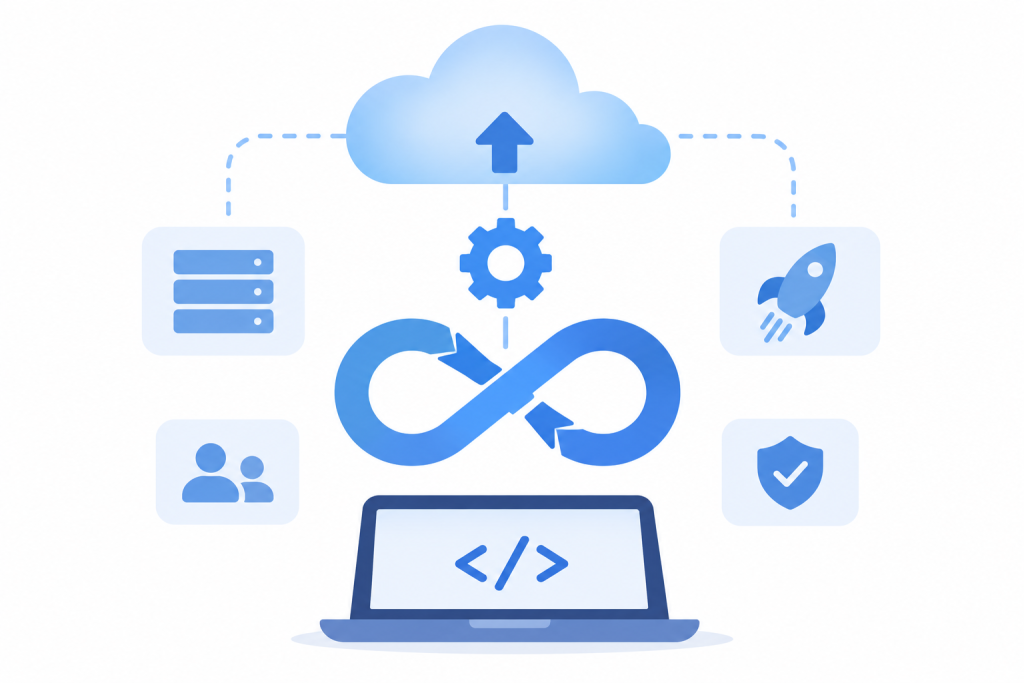
Platform Engineering plays a crucial role in enabling these capabilities and streamlining Cloud DevOps services.
Modern application development involves rapid release cycles against backgrounds of even more rapidly changing cloud configurations, leading to developers being asked to manage coding, infrastructure, CI/CD, monitoring, and deployments at the same time. The impact of these workloads can be delays and burnout.
Platform engineering lowers these pressures on developers by creating products for their internal consumption that speed application deployment, management, and scaling.
It is the development of internal products and systems by a specialized team of builders to automate and simplify tooling and workflows for developers within the organization.
Platform engineering is essentially developing tools to make devs within the organization more productive.
Most modern platforms include:
CI/CD pipelines
Infrastructure automation
Monitoring and logging
Security policies
Container tools
Orchestration tools
Subscribe to our newsletter for the latest updates, news, and features.
Why Is Platform Engineering Growing in 2026?
As development teams are increasingly expected to manage a variety of services, organizations will be more likely to embrace reducing operational overhead and prioritize developer satisfaction.
Some of the reasons for the increase are:
Growing Cloud Complexity
The greater the number of services and the more disparate the tools and processes needed to manage those services across cloud providers, the harder it is for teams to manage everything.
Growth of Microservices
Distributed applications tend to use container and orchestration tools like Docker and Kubernetes.
Simplify Your Cloud DevOps Today
Focus on Developer Experience
Ease of application development, testing and deployment is gaining importance for organizations.
Faster Release Cycles
Businesses are looking for ways to release software faster with reduced errors and mitigated risks.
How Does Platform Engineering Improve DevOps?
Traditional DevOps brings developers and operations teams together; however, the former still needs to take on a lot of infrastructure and operational tasks.
This can lead to:
Increased Workload
Heterogeneous Tools
Diminished Standardization
Increased Context Switching
Increased Cognitive Load
Platform Engineering provides tools, workflows and procedures that are executed frequently.
These technologies provide automation and help to reduce the burden of routine operational work.
Key Components of a Platform Engineering Platform
A modern internal platform can include several key components.
Component
Purpose
Self-service infrastructure
Empowers Developers with resource control, previously only able to be provided by Operations.
Standardized environments
Establishes consistency between Development and Production.
Orchestration
Deploys tools such as Kubernetes to deploy, manage, and scale applications in a given environment.
Observability
Implements health checks, logs, and alerts to verify the health of a system.
Security
Administrative controls over policies associated with development and deployment.
What Are the Benefits of Platform Engineering?
Benefits for Developers
Platform engineering can help developers:
Reduce activity context switching
Speed up process initiation
Reduce switching to coding
Improving application deployment
Benefits for Businesses
For businesses, platform engineering can support:
Reducing time to market on business products
Decreasing operational expenses
Increasing product reliability
Standardizes operational procedures
Platform Engineering vs Traditional DevOps
Aspect
Traditional DevOps
Platform Engineering
Responsibility
Shared across teams
Dedicated platform team
Complexity
Developers may handle more operational work
Common tasks are simplified
Developer experience
Can vary between teams
More consistent
Deployment
May require several manual steps
Uses reusable workflows
The two approaches are not opposites. Platform engineering extends DevOps practices by giving developers easier access to the tools and workflows they need.
Common Platform Engineering Use Cases
Platform engineering can support organizations in different ways.
SaaS Companies
Standardizes application deployment and reduces SaaS application release time.
Enterprises
Using Platform Engineering in large enterprise environments provides improved scalability.
Startups
Platform Engineering is suitable for managing multi-cloud environments.
How to Get Started with Platform Engineering
A good starting point for a platform does not require a large toolset. Start with the problems experienced by developers on a regular basis.
Step 1: Identify Pain Points
Observe what slows developers down or causes repetitive work.
Step 2: Create a Small Platform Team
Focused on internal tools and workflow builders.
Step 3: Add a Developer Portal
Single pane view to access services and deployment tools.
Step 4: Use Existing Tools
Use platform-building tools such as:
Docker
Kubernetes
Then add other tools as your platform needs grow.
What Challenges Should You Watch For?
One of the issues that can arise from platform engineering is teams building too much for developers.
Over-Engineering
Keep things simple. More complex tools mean more work for your developers. If you build too complex a platform, you lose the goal of simplifying your team’s work.
Low Adoption
Developers will not use a tool that’s more of a hindrance to their work, so building something developers do not need will lead to them ignoring the platform.
Poor Documentation
Good documentation eliminates the need for constant support. If developers do not have good documentation, then they will not use the platform.
How Do You Measure Platform Engineering Success?
The right measures should show whether the platform makes development and delivery easier.
Role
Success Indicator
Developers
Faster deployments
DevOps teams
Fewer support requests
Business leaders
Faster product delivery
Conclusion
Platform engineering provides a way for modern software teams to manage growing complexities. It helps build a platform focused on the developer workload, reduces operational work for the team and increases developer productivity.
Starting small and solving one developer problem at a time is the winning strategy for platform development.