


AI automation services for smart automation, predictive analytics, and reliable AI systems that support business workflows.
AI has become a major focus for businesses, but many projects never move beyond the pilot stage. Others fail after reaching production.
The failure often has to do with infrastructure and engineering. Any good model is only as reliable as the data backing it, proper systems, and regular updates, among many other things.
AI Engineering Services assist companies with building and deploying production-grade AI systems (e.g. to meet the needs of the business).
An Overview
What Are AI Engineering Services?
An AI model may be able to perform tasks in a test environment and even in production. AI engineering connects models to existing systems and processes of a company.
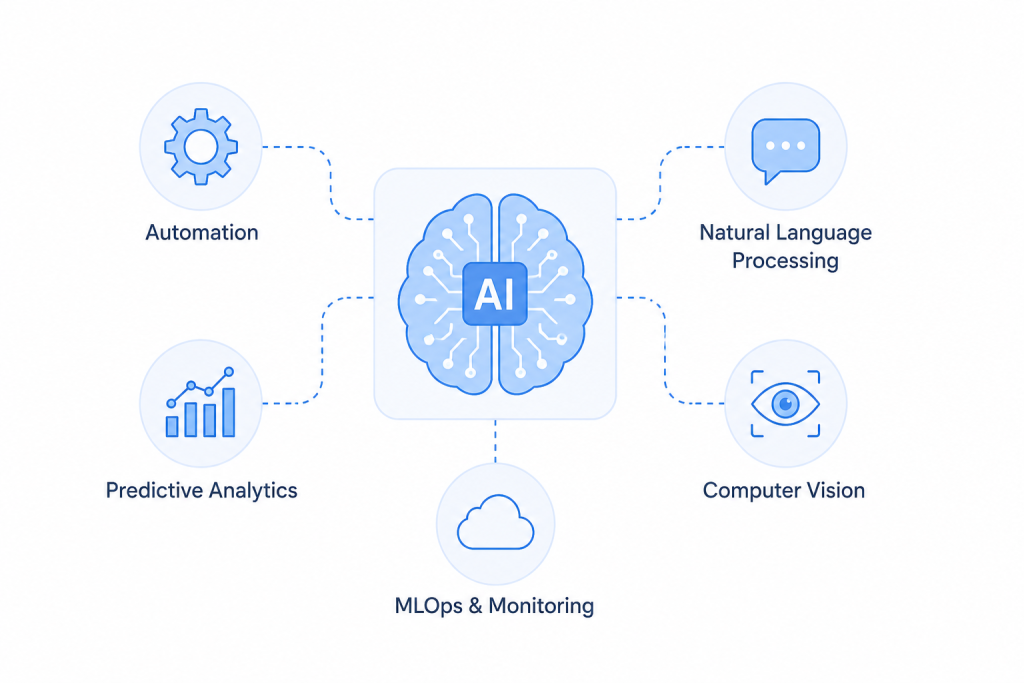
AI engineering covers five main areas:
| Area | Purpose |
|---|---|
| Intelligent Automation & Process AI | Automates repetitive tasks with machine learning |
| Decision Intelligence & Predictive Analytics | Analyzes data to make informed decisions and predict future events |
| Natural Language & Conversational AI | Helps automate search, analyze and process documents, and build virtual assistants |
| Computer Vision & Perception Systems | Processes images, video, and sensor data |
| MLOps & AI Platform Engineering | Automates and manages workflows for AI systems and pipelines |
Together, these areas help businesses build AI systems that can operate reliably in production.
Benefits of AI Engineering Services
Faster Processes
AI can tackle monotonous and repetitive back-office work, giving time for employees to focus on work involving judgment.
Better Decisions
Predictive systems help anticipate failure of machines, fraudulent actions, and customer loss. In such cases, companies can act in advance before these problems create a loss for the business.
Build Smarter AI Solutions.

Better Customer Experiences
AI enables companies to offer personalized experiences at scale.
Better Use of Data
Many companies have valuable data from their day-to-day operations, but lack tools to implement a predictive system. AI engineering fills that gap.
Key Challenges
Data Quality
AI systems require lots of good quality data. Without good quality data, the system will produce erroneous results.
Explainability
Complex models can be difficult to explain. However, businesses may need to understand why a system produced a particular recommendation.
System Integration
AI has to connect with legacy databases, applications and act on real-time data. These systems may be lacking the components that support machine learning.
Model Drift
After deployment, business activities and user behaviors change. Without proper monitoring and regular model updates, performance of models reduces over time.
When Should You Use AI Engineering?
AI can help when you have:
- High-volume processes with repeated decisions.
- Delays caused by manual data review.
- Valuable data that you are not using for prediction.
- A need for personalization at scale.
- A need to detect fraud, defects, failures, or compliance issues quickly.
- Large amounts of documents that require classification or data extraction.
However, AI is not always the right choice. If traditional software can solve a problem with simple rules, machine learning may add unnecessary complexity.
How to Build a Successful AI System
1. Define the Problem
Start with the business need.
Ask what decision you want to improve, who makes it today, and what a better result looks like.
2. Check the Data
Your data must be clean, organized, consistent and complete for your model to be able to interpret it properly. Check your data sources and identify any gaps where you might need to obtain more data or fill in gaps before model development.
Once the gaps in your data have been identified, you can create a reliable data ingestion, transformation and validation framework.
3. Choose the Architecture
Different use cases will necessitate different architectures for model predictions for real-time APIs, batch predictions or even edge-based predictions.
Setting these architecture decisions early will help you avoid costly changes in the future.
4. Validate the Model
It is important to start with a baseline that is usable, and from there improve the baseline.
Go beyond the typical evaluation metrics and assess how the model performs across various customer groups and/or business segments.
5. Release Carefully
Problems that arise during testing can sometimes fully or partially resolve themselves once the system is live. As a safety measure, consider the following methods for production deployment:
- Shadow mode
- Canary rollouts
- A/B testing
- Gradual releases
Additionally, you will need to decide how your system should behave when the model’s confidence is too low to make predictions.
6. Monitor After Launch
Post deployment, consider data and system changes that may affect your model’s accuracy, as well as input and output quality. Keep track of both data and model versioning, as well as retain rollback capabilities.
Also, decide how the model will behave and what the system will do if the model has low confidence.
AI Engineering Applications
Financial Services
Through transactional, credit, and behavioral data, ML enables teams to make better credit risk decisions and understand the factors that drive model recommendations.
Manufacturing
Predictive maintenance is further aided by the use of sensors in detecting equipment problems by analyzing data from vibrations, temperatures, and current draws.
Retail
Retailers can combine numerous sources to help with inventory management including retail sales history, promotions, events, etc.
Healthcare
Natural language processing can be used to automate manual data entry by cognitive capture. This also shortens the time to process documentation.
AI Engineering Best Practices
- Start with data: Check data quality before focusing on models.
- Plan for failure: Decide what happens when the model has low confidence, becomes unavailable, or receives missing data.
- Support explainability: Provide a way for users to view and understand important model outputs.
- Release gradually: Instead of replacing your model in one shot, give your system staged releases.
- Use feedback: Capture production outputs and human overrides to adjust model functionality.
- Track business results: Measure KPIs that indicate the success of your business along with technical performance metrics.
Conclusion
There are multiple elements to building a successful AI system beyond model construction. They include: reliable data, dedication to system integration, precise oversight, and clear architectural governance.
AI Engineering Services consolidates all of the aforementioned components and allows businesses to address real versus perceived production challenges. Through the build-up of a solution surrounding a specific challenge, data building, selection of architecture, gradual release, and monitoring performance, organizations are able to sustain AI systems with ongoing value.

