


Explore cloud cost optimization best practices covering visibility, FinOps, autoscaling, and smarter pricing models.
Cloud adoption has been growing rapidly over the past few years. Unfortunately, so have the bills that come with it. It starts as a flexible, pay-as-you-go model and soon turns into a significant and hard-to-control expense. Cloud costs are among the fastest-growing line items in the IT budget for many organizations today.
In fact, organizations waste about 32% of their spending on cloud services. This is a significant sum regardless of the size of the business. Much of this waste comes from a lack of visibility, poor resource management, and pricing models that are difficult to fully understand.
Cloud cost optimization is the practice of reducing cloud spending while maintaining or improving application performance and business value. It is about cutting costs and making sure your costs align with your business goals.
An Overview
Why Cloud Costs Get Out of Hand
Most organizations do not set out to overspend on cloud. It builds gradually, and several factors push costs higher than they need to be.
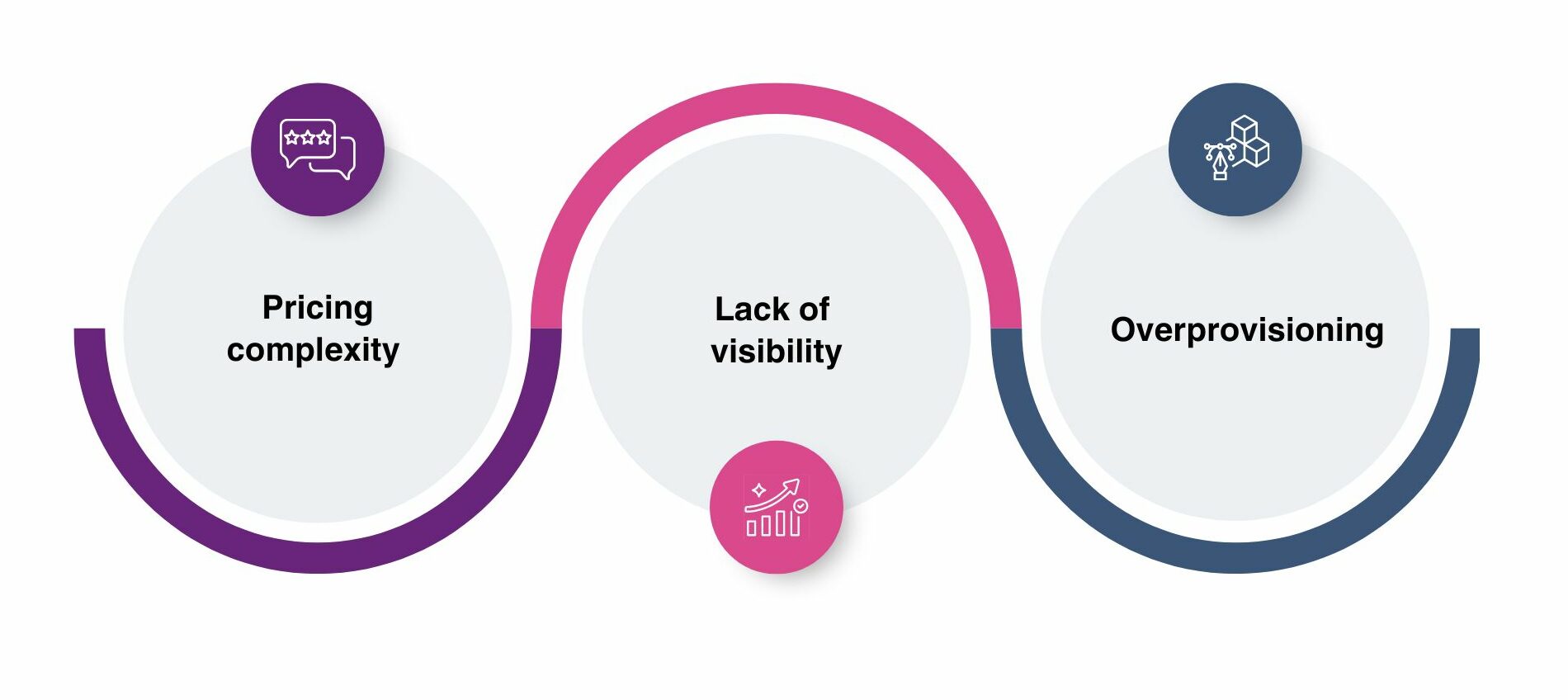
Pricing complexity is one of the biggest culprits. Cloud providers offer thousands of service combinations, each with its own pricing structure. Compute instances alone can vary based on region, instance family, operating system, and commitment level. Add in storage tiers, data transfer fees, API calls, and support plans, and the billing becomes difficult to predict.
Lack of visibility makes things worse. When cloud resources are not properly tagged or assigned to specific teams, projects, or cost centers, finance and engineering lose the ability to track spending. Resources become orphaned, and by the time someone notices, months of unnecessary charges have accumulated.
Overprovisioning is another common issue. Developers often provision resources for peak capacity, then leave them running at low utilization. Test environments stay active overnight and on weekends. Old snapshots and volumes pile up. As the organization grows, these small inefficiencies multiply fast.
How Cloud Pricing Models Work
The pricing model you choose directly affects how much you spend. Cloud providers offer a range of different pricing models and service levels that you can use to help match resources and costs with application needs, availability requirements, and business value. Here is a quick breakdown of the main options:
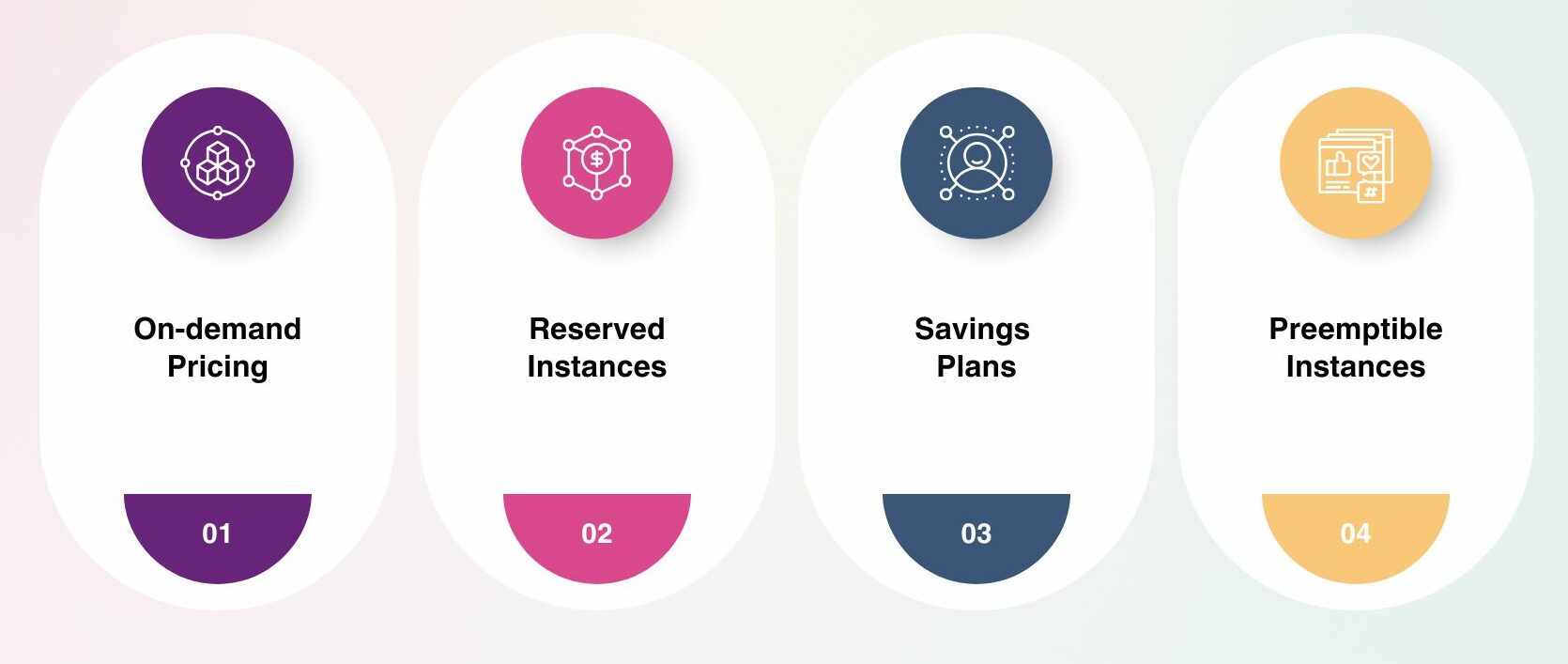
On-demand pricing is the default. You pay for what you use, by the hour or second, with no upfront commitment. It is the most flexible option, but also the most expensive, for workloads that run consistently.
Reserved instances are prepaid compute instances. These offer significant discounts, often up to 75%, which can be used over a defined period. They work well for stable, predictable workloads where you know your resource needs in advance.
Savings plans offer low prices based on one- or three-year commitments. They are more flexible than reserved instances and can be applied across different instance types and regions.
Spot or preemptible instances are leftover cloud capacity sold at steep discounts. Use cases for spot instances include processing big data and machine learning workloads, managing distributed databases, and running CI/CD operations. The trade-off is that these instances can be terminated at short notice.
Visibility and Cost Attribution
Organizations often find themselves surprised by their monthly cloud bills because they have no clear picture of where, exactly, the spending is occurring. That is why, before implementing cloud cost optimization strategies, you need a consolidated, unified view of all cloud-related expenditures.
A proper tagging strategy is central to this. Comprehensive tagging lets you track spending by business unit, application, environment, or project. This visibility creates accountability. When teams see their actual cloud consumption, they become more thoughtful about resource usage.
Cost attribution also matters for financial planning. Proper cost attribution helps finance teams allocate expenses accurately and make better budgeting decisions. Without it, cloud spending becomes a shared, anonymous cost that nobody feels responsible for managing.
Cut your cloud costs without compromising performance.

Building a FinOps Culture
FinOps is a cloud financial management practice that helps organizations maximize business value in their hybrid and multicloud environments. Many organizations approach cloud cost optimization strategy and implementation by employing a cross-functional FinOps team, with members from IT, finance, and engineering. This brings financial accountability to the cloud.
Engineers with real-time cost data and finance teams who understand technical constraints make decisions that balance performance with economics.
Forming a FinOps team that includes engineering, finance, and leadership is the tactical move here. This team is responsible for tracking, analyzing, and optimizing cloud spend across projects. By making cloud spend transparent and tying it directly to operational efficiency goals, you can turn cloud spend optimization into a team sport instead of a finance-only problem.
FinOps practices rely on reporting and automation to increase ROI by continuously identifying opportunities for efficiency and taking action in real time.
The FinOps Maturity Model: Crawl, Walk, Run
The FinOps Foundation describes maturity levels as “crawl, walk, run,” representing organizations that take action at a small, limited scale up to those at a much higher level.
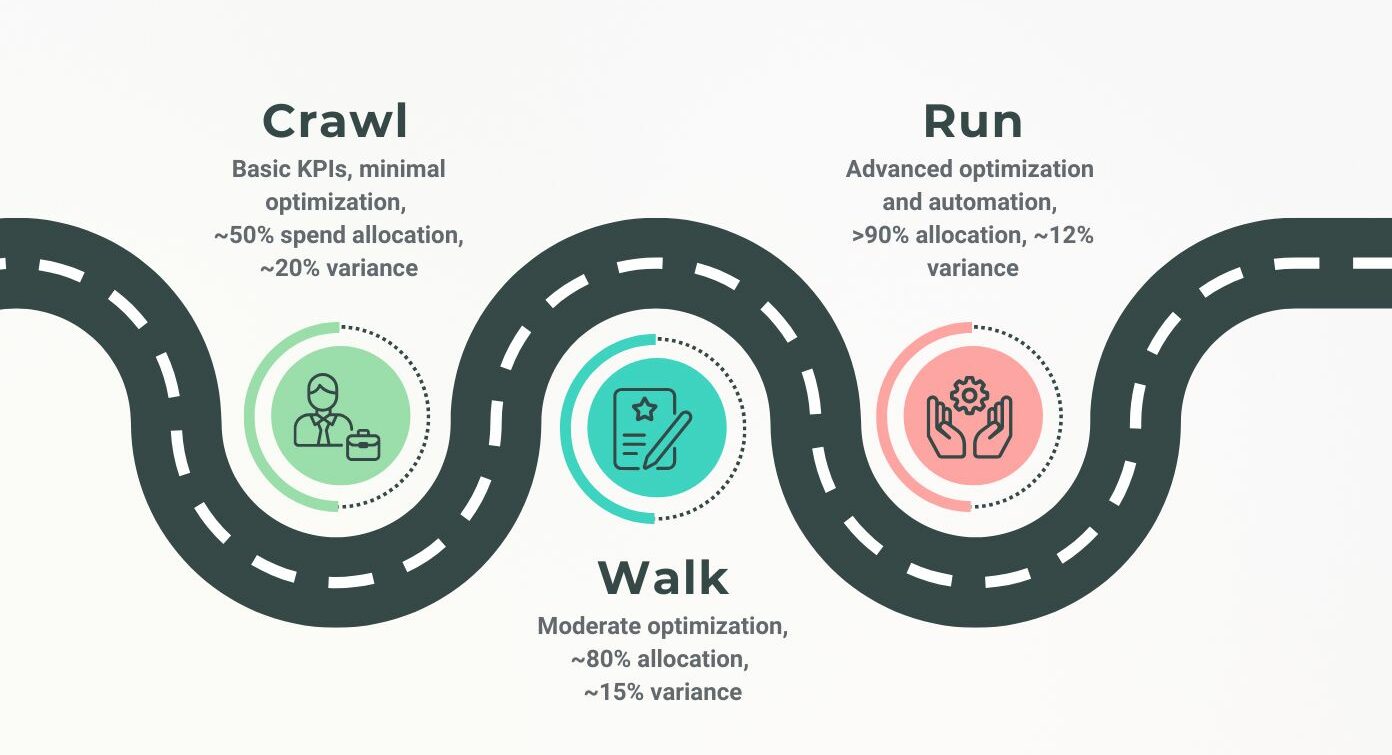
An organization at the Crawl level does minimal reporting and tooling, puts basic KPIs in place, and has plans to address only the low-hanging fruit. They allocate at least 50% of their cloud spend, and their forecast-to-spend accuracy variance is around 20%.
At the Walk level, the organization understands and follows cloud optimization capabilities. They identify difficult edge cases but do not yet address them. They allocate about 80% of their cloud spend, and the difference between their forecast and actual cloud spend is around 15%.
Organizations at the Run level have teams that fully understand cloud optimization capabilities and execute them in cloud operations. They address difficult edge cases, prefer automation, and allocate more than 90% of their cloud spend. Their forecast-to-spend accuracy is about 12%.
Cloud Cost Optimization Best Practices
This is where awareness turns into action. Here are a few ways to consistently deliver results across organizations of all sizes.
Rightsize Compute and Storage
Most workloads run on instances that are larger than necessary. Rightsizing means matching instance types to actual resource consumption. If your application uses 20% of available CPU and memory, you are likely overpaying. Downsizing instances or switching to different instance families can cut compute costs by 30–50% without affecting performance.
Start by analyzing CPU, memory, disk, and network utilization over at least two weeks to capture usage patterns. Instances that consistently run below 40% utilization are prime candidates for downsizing.
Turn Off Idle and Unused Resources
Developers are great at spinning up compute instances, load balancers, and storage volumes when they need them. But they are not nearly as enthusiastic about cleaning them up afterward.
Development and staging environments rarely need to run 24/7. Shutting down non-production resources during off-hours can reduce costs by 65–75% for those workloads. Automated scheduling makes this straightforward to implement.
Over time, backups and snapshots multiply, and before you know it, your storage costs are outpacing your growth.
Use Commitment-Based Discounts
For predictable workloads, leveraging commitment-based discounts is how you pick the low-hanging fruit. Rather than paying on-demand rates for resources you know will be running constantly, you lock in one- or three-year commitments at significantly reduced rates.
Reserved instances and savings plans typically reduce compute costs by 30–70% compared to on-demand pricing. The key is matching commitment levels carefully to actual usage patterns so you neither overcommit nor undercommit.
Use Autoscaling
Autoscaling gives your infrastructure a brain. It knows when to grow, when to shrink, and most importantly, when to stop consuming resources for no reason. Resources expand and contract automatically based on real-time demand.
Well-configured scaling policies can reduce costs by 40–60% for variable workloads while maintaining performance during traffic spikes.
Optimize Storage with Tiered Policies
If you are keeping infrequently accessed data in expensive regional storage, you are paying more than you need to. Moving data to cheaper storage tiers based on how often it is accessed can deliver significant savings.
Automated lifecycle policies handle this transition based on access patterns, ensuring you are not paying for high-performance storage when you do not need it. Moving infrequently accessed data to archive solutions can reduce storage costs by 80–90%.
Reduce Data Egress Costs
Every time your data moves outside its home environment, it costs money. Many companies do not even realize how inefficient their data transfer strategies are until the bill arrives.
Strategies include minimizing cross-region traffic, using content delivery networks efficiently, and understanding which data flows incur charges. For hybrid architectures, direct connection solutions can reduce transfer costs while improving performance.
Adopt Serverless and Managed Services
Serverless and managed services represent the less-code, less-cost approach in modern cloud cost optimization. Managing VMs and infrastructure manually is becoming increasingly unnecessary. Today’s lean teams are turning to managed services that adjust to demand and budget automatically.
While these services sometimes cost more per unit of compute, they often reduce the total cost of ownership by improving utilization and reducing operational overhead.
Automate Cost Controls and Anomaly Detection
People are not reliable at remembering to turn things off, especially when they are busy. That is why automated policies for managing cloud spend are essential. This starts with setting real-time budget alerting and anomaly detection. If a non-production environment suddenly generates a large unexpected bill, you want to know about it before it burns through your quarterly budget.
Automated anomaly detection catches unexpected spending increases before they become major problems. Real-time alerts let teams respond quickly to configuration errors, security incidents, or usage spikes that drive up costs.
Table 1: Commitment-based pricing options and when to use them
| Pricing Model | Typical Discount vs On-Demand | Best For | Risk Level |
|---|---|---|---|
| Reserved Instances | Up to 75% | Stable, predictable workloads | Low if usage is consistent |
| Savings Plans | 30–70% | Flexible compute commitments | Low to medium |
| Spot / Preemptible | Up to 90% | Batch jobs, CI/CD, fault-tolerant workloads | High (can be terminated) |
| On-Demand | No discount | Variable or unpredictable workloads | Lowest commitment risk |
Key Metrics to Track
Optimization only works if you are measuring the right things. Tracking a few focused metrics tells you where you stand and how much progress you are making.
If you want to manage cloud spend, you cannot just look at the total cost. You need to break it down into real, actionable metrics. Unit economics is foundational to managing cloud costs the right way.
Table 2: Key cloud cost metrics and what they tell you
| Metric | What It Measures | Why It Matters |
|---|---|---|
| Unit cost | Cloud spend per transaction, user, or API call | Links cloud investment to business value and ROI |
| Idle resource cost | Spend on unused or underutilized resources | Highlights waste and inefficiency directly |
| Waste rate | Percentage of total spend on idle resources | A waste rate above 25% signals major savings opportunities |
| Forecast variance | The gap between the budgeted and actual spend | Large gaps indicate forecasting or governance issues |
| % spend under committed pricing | Share of compute covered by reservations or savings plans | Higher percentages reflect better cost discipline |
Common Challenges
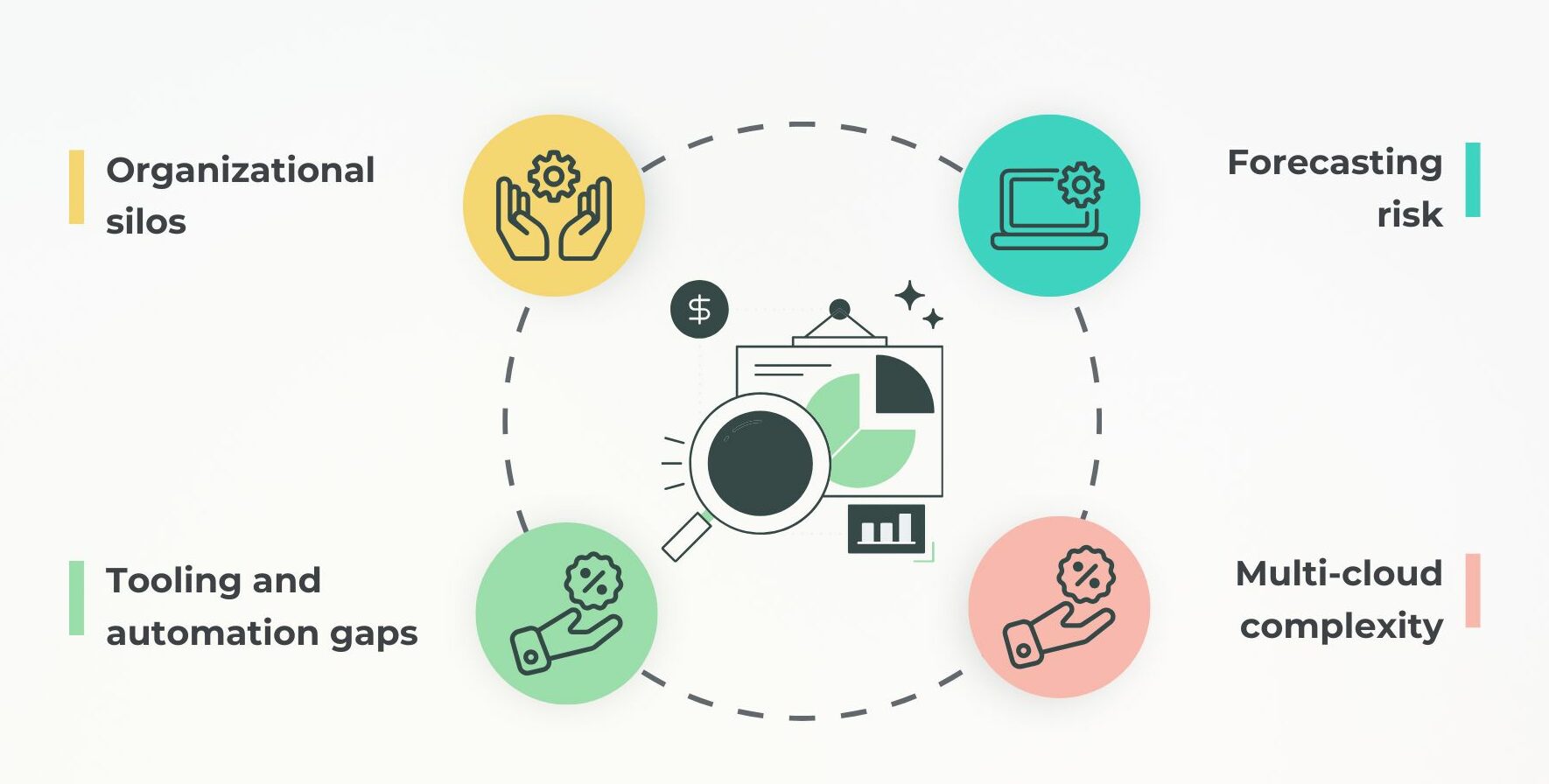
Organizational silos are among the most common. Finance teams want predictability and cost control. Engineering teams prioritize performance and agility. These competing priorities create tension. FinOps practices bridge this gap by creating shared accountability and a common language.
Forecasting risk trips up many teams. Committed use discounts require accurate forecasting. Overcommit and you pay for capacity you do not need. Undercommit and you miss savings opportunities. Starting conservatively and using historical data to identify stable baseline workloads reduces this risk.
Tooling and automation gaps slow progress. Many organizations lack the tools to implement optimization strategies at scale. Manual processes cannot keep up with constantly changing cloud environments. Investing in cost management platforms and automation tools turns optimization from a periodic exercise into a continuous capability.
Multi-cloud complexity adds another layer. Organizations using multiple cloud providers face additional complexity, as each platform has different pricing models, optimization tools, and best practices. Understanding the strengths of each platform and placing workloads accordingly creates a real competitive advantage.
A Roadmap to Get Started
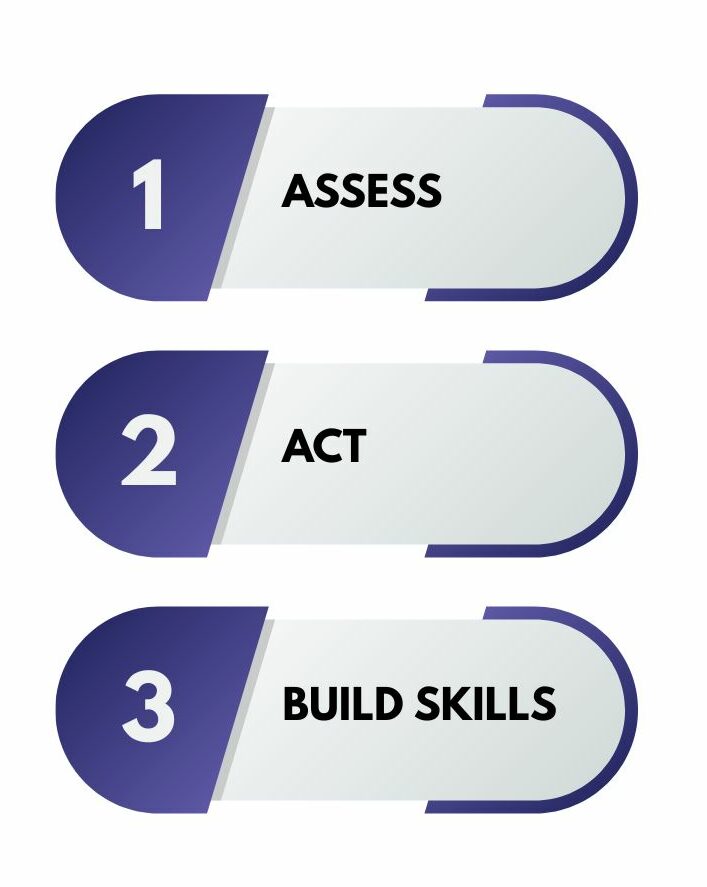
A phased approach prevents overwhelm and builds momentum with early wins.
Phase 1
Start by auditing your current cloud environment. Look at resource utilization, tagging compliance, and spending patterns. Identify which resources are idle, which are oversized, and where costs are unattributed. This baseline gives you a clear picture of where the biggest savings opportunities lie.
Phase 2
Choose two or three high-impact, low-risk changes to implement first. Shutting down idle non-production environments, rightsizing a handful of over-provisioned instances, and purchasing reserved instances for your most stable workloads are good starting points. Early wins build confidence and demonstrate value to stakeholders.
Phase 3
Put ongoing monitoring in place. Set up budget alerts and anomaly detection so that cost spikes are flagged immediately. Establish a regular review, monthly for spending trends, quarterly for broader strategy alignment. As your forecasting accuracy improves, you can increase commitment levels without taking on excessive risk.
Conclusion
Cloud cost optimization is not a one-time project. It is an ongoing discipline that requires visibility, the right organizational culture, and consistent action. Sustainable cloud cost management requires a shift in how your organization thinks about cloud spending.
The good news is that the savings are real and achievable. The organizations that manage cloud costs well are not the ones that spend the least. They are the ones who spend the most deliberately.

