


Often web hosts get contacted by account owners who are unable to send or receive emails via Outlook. The error message they see in their Outlook would be:
Task '[email protected] - Sending' reported error (0x80042109) : "Outlook cannot connect to your outgoing (SMTP) e-mail server. If you continue to receive this message, contact your server administrator or internet service provider (ISP)."
In our role as Website Support for web hosting companies, this is a concern we quickly resolve for users who have email accounts hosted in the customers’ servers.
As a one-size-fit-all solution is not possible for this error, today we’ll see what are the common causes for this error and how we resolve them for the customers.
What causes ‘Outlook cannot connect to SMTP server’ error
The SMTP error in Outlook can happen due to many reasons, broadly classified into these categories – 1. User end issues 2. ISP issues 3. Server side issues.
1. PC/Laptop firewall issues
Though not so common, third party firewalls and anti-virus software in user PCs can block connection to certain IP ranges, which could include the server IP as well. This can give errors while connecting to the mail server for sending or receiving mails.
To check the connectivity issues from user’s PC or laptop to the mail server, we get the results of ‘telnet domain.com 25’ from the users, which shows whether the user is able to connect to the SMTP port in the mail server.
2. Outlook configuration mistakes
Most common reason for ‘Outlook cannot connect to SMTP server’ error is the wrong configuration settings of Outlook. This happens especially in the case of newly configured email accounts.
A mis-spelled mail server name to a wrong port setting in Outlook can cause connectivity issues to the mail server and end up giving error while trying to send or receive mails.
By default, the port settings for mail related services are these, and a connection problem to these ports can lead to Outlook error:
SMTP - port 25 / 587
POP3 - port 110
IMAP - port 143
Secure SMTP (SSMTP) - port 465
IMAP4 over SSL (IMAPS) - port 993
Secure POP3 (SSL-POP) - port 995
There are also chances that some web masters may have duplicate profiles in Outlook, which will have an old mail server configured in it, and therefore would be trying to connect to the wrong mail server.
[ You don’t have to lose your sleep over lost emails. Get our professional help to fix your mail errors. ]
3. ISP firewall issues
Some ISPs are known to block traffic through port 25 to minimize automated spam. This is the most common reason for Outlook error 0x80042109 ( ‘Outlook cannot connect to SMTP server’ ).
A ‘traceroute’ result to the mail server from the user end helps to reveal if there are any connectivity issues in any of the intermediate network between user PC and mail server.
4. Server firewall issues
Firewalls are the security barriers which we setup in servers to protect them from malicious attacks or hacks. Occasionally, these server firewalls can block certain IPs or IP ranges based on any anomalous behavior.
For instance, exceeding the login failure attempts or too many connection attempts to the server can lead to an IP address being blocked in the server firewall. This can lead to error ‘Outlook cannot connect to SMTP server’.
The above were some common reasons for Outlook error 0x80042109. In our website support services, we treat each customer as unique, and explore all possibilities before giving a final solution.
How we resolve ‘Outlook cannot connect to SMTP server’ error
We follow a unique step-by-step debugging process to resolve the Outlook error 0x80042109 for the customers, in minimal time.
1. Resolving client end issues
When a user reports the error, we check the server logs to see if the user is able to establish a connection successfully to the mail server via webmail or other mail clients.
If the user can successfully connect to mail server IP and ports for SMTP and POP, then the issue is with the Outlook settings and not connectivity problem. We verify this using ‘telnet’ and ‘traceroute’ results.
We then assist users with the correct steps to configure their Outlook mail client, with the port number, SSL settings and mail servers to be used.
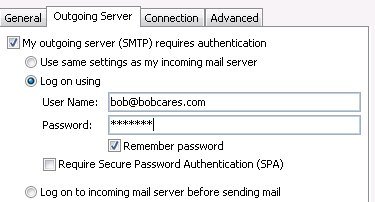
Outlook SMTP configuration
2. Resolving ISP or network issues
For ISP or network connectivity issues, we suggest alternate methods to the users to connect to the mail server and send mails.
To override ISP port blocks and to enable users to send mails, we usually configure SMTP on a different port in our servers. Using a non-standard port such as 587 also helps to secure our email server.
Once the mail server is configured to listen to the new port, we also add this port to the firewall white-list to allow incoming connections to that port.
[ Need help resolving email errors in your sites? Get assistance from our server experts to fix your website. ]
3. Resolving server side blocks
Looking for the customer’s IP in the server’s firewall is one of the first things we do when we don’t see a recent connection on other service logs. User’s IP addresses can be identified using tools such as ‘http://whatismyipaddress.com/’
Once the IP is found to be listed in the firewall, we immediately unblock it to establish connectivity for the customer. There are different types of firewall such as CSF, iptables, etc. and the de-listing method varies in each.
[ Are your users complaining about email errors? Get our server specialists’ assistance to fix your mail server. ]
As recurrent IP blocks can lead to discomfort and loss of time and effort for the end users, we strive to reduce the inconvenience caused to customers with these pro-active steps:
- Regularly auditing the server logs to examine IP blocks and unblock valid IPs.
- White-listing IP addresses of customers after verification.
- Setting custom firewall rules for customers to prevent discomfort but avoid misuse.
If you’d like to know how to provide a delightful customer support experience to your email users, we’d be happy to talk to you.


Hi,
this is the best support site I have ever visited.
Thanks mate, you resolved my issue.
I am 100% happy and hope you continue to do this wonderful work.
Cheers!
Mansoor
Thank you for the kind words Mansoor 🙂
It says that I can’t send mail and says the connection to the outgoing server has failed please help
Hi Jordan,
Our experts can help you with the issue.we will be happy to talk to you through our live chat(click on the icon at right-bottom).
yo tenía el mismo problema, lo que hice fue restaurar a los valores predeterminados del firewall de windows y se solucionó el problema.
Thank you Joel. 🙂
English translation of Joel’s comment :
I had the same problem, what I did was restore to the default values of the windows firewall and the problem was solved.
IT WORKED!!!!!! 587 was the magic number
Over two hours trying to get this setup…
Thanks!!!!!!!!!!!!!
Need help to resolve
Task ‘[email protected] – Sending’ reported error (0x800CCC67) : ‘ The server responded: 421 please try again later’
Hi Hari,
This could be the issue you are facing:
https://bobcares.com/blog/how-to-fix-error-421-too-many-concurrent-smtp-connections-in-cpanel-directadmin-servers/
If not, contact us by clicking here, and we’ll take a look at your email account.
Thnx, using 587 port
“Log onto incoming mail server (POP3): The operation timed out waiting for a response from the receiving (POP) server. If you continue to receive this message, contact your server administrator or Internet service provider (ISP).”
Outlook 2013 settings are
In 993 ssl
out 587 ssl
Hi Phillip,
Looks like either your POP3 server is down, or your network is is broken or your IP is blocked in the server.
You can talk to our experts by clicking here if you are still facing this error.
“Log onto incoming mail server (POP3): Outlook cannot connect to your incoming (POP3) e-mail server. If you continue to receive this message, contact your server administrator or Internet service provider (ISP).”
I have kept receiving this message, which does not allow me to log on to my mail.
Any assistance, please.
You can talk to our server admins by clicking on the chat icon on right bottom of this page.
Thanks a lot.
Very useful and fix my issue
Hello,I have problem with old version (ms.office 2007 and 2010) of office but new version it’s working normal (ms.office 2013 and 2016).I try to config many day but still not working,I don’t want to reinstall the new version, Please help me guy
You can talk to our server admins by clicking on the chat icon on right bottom of this page.
error code 0x800ccc69
Hello,
Please contact our support team via live chat(click on the icon at right-bottom).
Hello,
I’m having trouble setting up my outlook 2016.I tried with a gmail adress and Outlook tells me We couldn’t log on to the incoming imap server.I enabled imap in gmail’s settings,I allowed unsafe apps to acces my email but nothing works.
Hello,
If I sent email from web mail in outlook other person can not receive my email
but if i send email from web mail in browser other person can receive my email
Please help me
IT WORKED!!!!!! 587 was the magic number
Over two hours trying to get this setup…
Thanks!!!!!!!!!!!!!
Thank you Bob. I would have never known to use 587 in lieu of 25. IT WORKS!!!
Good to know it worked for you. 🙂
I am setting my outlook email, and i am receiving the error …the outgoing (SMTP) server does not recognize your account. Please check your email address and try again
Hello Nick,
Apologize for the delay in reply. If you still need help in configuring the email account in Outlook, we’ll be happy to talk to you on chat (click on the icon at right-bottom).
587 doesn’t work for me
Hello Tony,
Do you have port restrictions at your internet service provider? If you need assistance in sending emails, our experts can help you further. We’ll be happy to talk to you on chat (click on the icon at right-bottom).
I think i’ve Been hacked, I can’t seem to get into my outlook account and I can’t change my password. I tried to get sent a verification code to my number but nothing was sent to me!
Please help
Hello Joel,
Can you please try to reset the password from the official website. If you still find problems, we’ll be happy to talk to you on chat (click on the icon at right-bottom).
I installed outlook 2019 pro plus it will not let me connect to my mail server.
smtp which i can setup in a gmail in outlook.
but, i installed outlook 2007 i can access the server and all the email works just like it did on my other systems. ALL IMAP.
unistall 2007 and reinstall 2019 i get the error again cannot connect to outgoing SMTP server. and outlook will not let you set up an email account.
anyone have the same error ?
anyone have an answer?
my firewalls are all down.
2022 – For all those that just started having problems. Outlook changed their POP and SMTP servers (without really notifying users). Go to Account Settings > E-mail > highlight your account (msn/outlook/live/hotmail) > Change tab > Change Account popup > change the following settings to . . .
Incoming mail server: pop-mail.outlook.com
Outgoing mail server (SMTP): smtp-mail.outlook.com
If you’re still receiving incoming email, then you may not have to change incoming setting for now, yet, will most likely have to in future, so might as well do it now.
Unfortunately it took me 4 days and 12 different tries (ports, authentications, security, firewall, anti-virus changes) to finally find that they had just changed their servers.
Thank you so much, RedCardinal. Your solution worked for me, and I can imagine will resolve the issues many others are having.
I’m using the stock Apple mail app on my iPad and all of a sudden my pop outlook account cannot send emails. It can receive fine. I set up an additional imap version of the same account and that one has the same problem.
I’ve tried using a different vpn, I’ve tried different servers (even though I’m using 587 and I know it’s correct.
The same email account with the same server info etc works fine on my Mac and my iPhone and on the outlook stock app. Just not on mail.
Any idea?
Hi,
Please contact our support team via live chat
I am having trouble with outlook just started today. I have tried everything to fix it
Outlook cannot connect to your incoming (POP3) e-mail server
Outlook cannot connect to your outgoing (SMTP) e-mail server
Hi Lisa,
Our Experts can help you with the issue, we’ll be happy to talk to you on chat (click on the icon at right-bottom).
Trying to get home mail on cell but get unable to connect to email server to verify account info.
Unable to connect to email server to verify your account info. Have tried 25 and 587 no luck
Hi,
Our experts can help you with the issue.we will be happy to talk to you through our live chat(click on the icon at right-bottom).