Bobcares Logo
Search Call 1-800-383-5193 Emergency Contact
Bobcares Logo
Search Call 1-800-383-5193 Emergency Contact
Emergency Contact

WMI Error: Login to remote object in Nagios – How to solve it

by Nicky Mathew | May 16, 2021 | Latest, Server Management | 0 comments

WMI Error: Login to remote object

Generally, we receive this error when we run the WMI Configuration Wizard.

As part of our Server Management Services, we assist our customers with several Nagios queries.

Today, let us see how we can resolve the WMI error, Login to remote object.


WMI Error: Login to remote object

WMI can provide management data and operational information about Windows systems.

Nagios Core and Nagios XI are capable of monitoring Windows machines via WMI.

When we run the WMI Configuration Wizard, we receive the error:

UNKNOWN – The WMI query had problems. The error text from wmic is: [wmi/wmic.c:196:main()]
ERROR: Login to remote object.
NTSTATUS: NT code 0x800706ba – NT code 0x800706ba

It is possible that the Windows Firewall is not allowing the traffic through. This can be the cause of the error.


How to solve the error?

In Windows Firewall, under Allowed Programs, we ensure WMI is enabled.

Windows Server 2008/2012/2016 Firewall Rules

To check firewall settings, we select Start and search firewall and open Windows Firewall with Advanced Security.

In Server 2012/2016, we can find it at Server Manager > Tools > Windows Firewall with Advanced Security.

Here, in the left-hand pane, we click Inbound Rules. In the right-hand pane, we click Filter by Group and then select WMI.
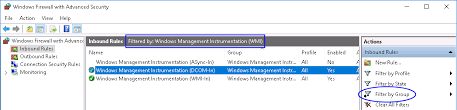
WMI Error: Login to remote object in Nagios

Then we will see the available firewall rules. We ensure to enable the DCOM-In and WMI-In rules.

If the WMI rule group does not exist, Microsoft suggests the below method.

In the command prompt we enter:

netsh advfirewall firewall add rule dir=in name=”DCOM” program=%systemroot
%\system32\svchost.exe service=rpcss action=allow protocol=TCP localport=135

netsh advfirewall firewall add rule dir=in name =”WMI” program=%systemroot
%\system32\svchost.exe service=winmgmt action = allow protocol=TCP localport=any

netsh advfirewall firewall add rule dir=in name =”UnsecApp” program=%systemroot
%\system32\wbem\unsecapp.exe action=allow

netsh advfirewall firewall add rule dir=out name =”WMI_OUT” program=%systemroot
%\system32\svchost.exe service=winmgmt action=allow protocol=TCP localport=any

Windows Server 2003 Firewall Rules

By default, DCOM communicates with the client on a random port, so in order to write firewall rules, we can specify a port range.

  1. To do so, we click Start, choose Run, type DCOMCnfg.exe, and click OK.
  2. Then we expand Component Services > Computers > right-click My Computer > Properties.
  3. In the Default Protocols tab > Properties > Add.
  4. We add a port range for COM services. For example, a range from 5000-5020.
  5. Once done, we click OK.

Eventually, we allow the port range through the windows firewall.

  1. The below command will open ports from 5000-5020 to match the COM Internet Services Range.
  2. FOR /L %I IN (5000,1,5020) DO netsh firewall add portopening TCP %I “COM”%I
  3. Lastly, we open DCOM port 135.
  4. Then in the command prompt, we type:
    netsh firewall add portopening TCP 135 “DCOM”

[Need help with the procedures? We’d be happy to assist]


Conclusion

In short, we saw how our Support Techs fix the WMI error for our customers.

Related posts:

    1. WMI ERROR: Retrieve result data – How to resolve
    2. Permission denied WMI error in Nagios – How to resolve setup error
    3. Need at least 2 WMI samples% – How to resolve the error
    4. WMI errors in Nagios – Troubleshoot and fix the errors

Submit a Comment Cancel reply

Your email address will not be published. Required fields are marked *

Recent Posts

  • What Is Proactive Monitoring? A Complete Guide
  • AI Use Cases: How Artificial Intelligence Is Used Across Industries
  • Turn Manual Business Processes into Automation-Driven Growth
  • Digitalization of Business to Speed Up Operations and Support Faster Scaling
  • Cloud Cost Optimization Best Practices: Everything You Need to Know in 2026

Categories

  • Advanced Vulnerability
  • AI Services
  • AI Support
  • AIOps
  • Amazon Web Services (AWS)
  • Apache
  • API Integration
  • Application Development
  • Azure
  • Cloud Cost Optimization
  • Cloud Management
  • Cloud-Native Application
  • Cloudflare
  • cPanel
  • cPanel migration
  • Cyberpanel
  • DDoS
  • Development Service
  • DevOps
  • DevOps Consulting
  • DevSecOps
  • Digital Transformation
  • DigitalOcean
  • DirectAdmin
  • Docker
  • Drupal
  • Ecommerce
  • Filezilla
  • FTP
  • Google cloud platform
  • HAProxy
  • Headless CMS Integration
  • Hosting Support
  • IIS
  • Infrastructure Management & Optimization
  • Kubernetes
  • KVM
  • Laravel
  • Latest
  • Linode
  • Litespeed
  • LXC/LXD
  • Magento
  • Mobile App Development
  • MongoDB
  • Moodle
  • MySQL
  • NFS
  • Nginx
  • OnApp
  • Outsourced Support
  • OVH
  • ovirt
  • pfsense
  • Plesk
  • PostgreSQL
  • PowerDNS
  • Product Engineering
  • Proxmox
  • RedHat
  • Redis
  • Sendmail
  • Server Administration
  • Server Management
  • Software Development
  • Software Testing
  • SQLServer
  • Technical Support
  • UI/UX
  • Virtualizor
  • VMware
  • VPN
  • Vulnerability Scanning
  • Vultr
  • Web Development
  • Windows
  • WordPress
  • WordPress Hosting
  • WordPressHA

Subscribe to our newsletter

Footer newsletter

Email sales@bobcares.com | Phone 1-800-383-5193

Product Engineering

  • MVP Build
  • MVP to Scale
  • Product Maintenance

Digital Transformation

  • Process Digitization & Automation
  • Systems Integration & Workflow Orchestration
  • Data Enablement & Decision Support
  • Application & Platform Modernization
  • Transformation Execution & Delivery Enablement

AI Services

  • AI Readiness & Use-Case Discovery
  • AI Integration & Application Enablement
  • Intelligent Automation & AI Workflows

Infrastructure Management

  • Always-On Infrastructure Management
  • Proactive Monitoring & Incident Prevention
  • Cloud Cost Control & Optimization (FinOps)
  • Outsourced IT & End-User Support
  • Managed Infrastructure Execution Support

DevOps & Automation Services

  • CI/CD & Release Automation
  • Infrastructure as Code & Platform Standardization
  • Reliability Engineering & Observability
  • DevSecOps Enablement
Product Engineering +
Web Development MVP to Scale Builds Microservices Architecture Agile & Dev Team Augmentation Mobile Apps Ecommerce UI/UX Design QA & Test Automation
Digital Transformation +
Legacy Modernization Workflow Automation Data-Driven Dashboards CRM / ERP Integration Business Process Re-engineering
AI Services +
AI & Machine Learning AIOps Intelligent Automation Business Intelligence & Analytics AI Installation & Compute
Infrastructure Management +
Cloud Setup Cloud Migration Managed Cloud Services Server & Hosting Cost Optimization Performance Optimization Outsourced Support
DevOps & Automation Services +
CI/CD Setup Kubernetes & Docker Infrastructure as Code Cloud-Native Migration DevSecOps
Cybersecurity & Compliance Services +
Security Hardening VAPT Incident Response Backup & DR

© 2026 Bobcares. All Rights Reserved.

  • Careers
  • |
  • Cookie Policy
  • |
  • GDPR
  • |
  • Privacy Policy
  • |
  • Terms and Service
  • LinkedIn
  • YouTube
  • Instagram
  • Facebook

Preview of the new Bobcares experience
NEW UPDATE
See What’s New
at Bobcares

Discover a faster, clearer view of our services and expertise.


Explore the New Experience
Arrow Right